

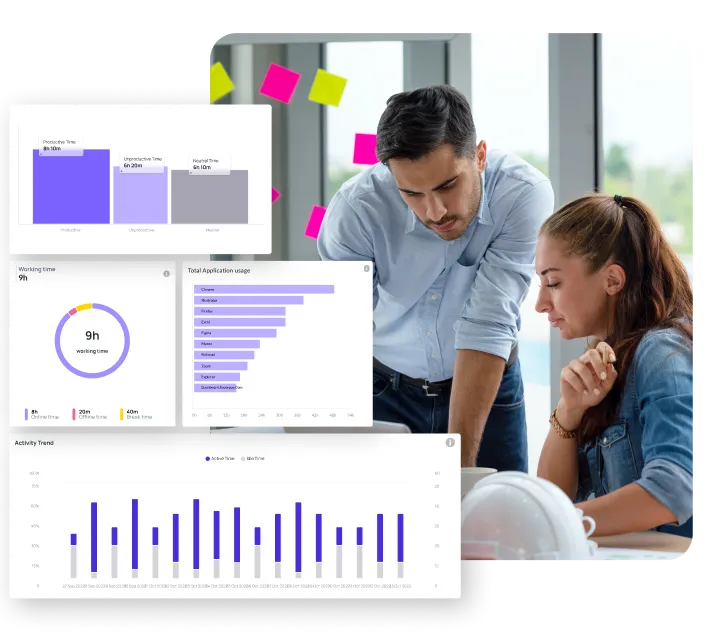
Picking employee monitoring software takes time. You want data that helps without creating new headaches around privacy or setup. Controlio software gives managers productivity scores and early signals on team strain. Teramind focuses harder on catching security slips and insider moves.
Many start their employee monitoring search by weighing these two options. If neither clicks right away, you can also review more Controlio alternatives.
What Controlio brings to the table
Controlio software turns activity data into scored KPIs that actually show who carries too much and who coasts. The system flags burnout patterns through consecutive overload stretches and break habits. Managers get heat maps and trend lines instead of raw logs they have to decode themselves.
You turn on screen recording only when specific rules fire. File tracking, email logs, and print monitoring stay optional too. That keeps the default footprint lighter for most users. Compliance modes for GDPR, HIPAA, and similar rules sit one click away with encryption and audit logs already in place.
Deployment runs in the cloud or on your own servers. Windows and macOS both work without forcing extra agents everywhere. Custom profiles let different departments run different levels of visibility from day one.
How Teramind handles deeper security
Teramind watches fifteen-plus channels at once. It logs keystrokes, tracks file moves across cloud drives and USBs, and keeps continuous video with DVR-style playback. Security teams get entity behavior baselines that flag odd patterns before a leak turns into a breach.
The rules engine can auto-block actions like copying sensitive files to personal accounts. OCR on captured screens helps spot keywords tied to company data. Deployment covers cloud, on-premise, and government cloud setups, which matters for regulated industries that need data in specific locations.
Setup and tuning take real work. Reviewers often mention the time required to build effective policies and the extra help needed for larger rollouts. Mac support lags behind Windows in some areas according to long-term users. The tool leans invasive by design, which can raise stress levels inside teams that just want output visibility.
Where the two tools split on daily use
Controlio surfaces workload balance and focus metrics that feed straight into coaching conversations. Teramind surfaces the same activity data but routes it toward risk scores and alert queues first.
Screen capture stays optional and trigger-based in Controlio. Teramind records screens all the time unless you heavily customize. That single difference changes how employees perceive the system and how much pushback you get during rollout.
Pricing for Controlio ties more to storage length and the features you actually switch on. Teramind starts higher and climbs with its UAM and DLP tiers, plus a five-user minimum that hits smaller groups harder. Both offer trials, yet the cost curve feels steeper once Teramind scales past the basics.
Controlio dashboard reading takes less ramp time for operations managers who care about output per person. Teramind rewards security specialists who need forensic depth and are willing to invest configuration hours. Neither tool claims to replace good management, but each surfaces different signals.
How to decide for your situation
Start with the risk that keeps you up at night. If productivity gaps and burnout signs matter most right now, Controlio software lines up with that need. The AI scoring and early overload alerts give concrete numbers for workload talks without forcing constant screen grabs.
If data leaks and insider actions sit at the top of the list, Teramind brings heavier blocking and continuous evidence collection. Regulated environments with strict sovereignty rules often lean this way because of the deployment choices and depth of logging.
Some teams run lighter productivity monitoring on most groups and layer deeper security tools only on roles that handle sensitive material. That hybrid path avoids paying for full forensic features across the whole company while still protecting the real exposure points.
Test both on a small pilot group. Watch how the data actually gets used in weekly reviews and whether the alerts create noise or clarity. The tool that matches your culture and primary pain point will stick. The one that fights your workflow will get ignored after the first month.
Final words
Controlio and Teramind solve different core problems even though both fall under employee monitoring. One leans into output visibility and team health. The other leans into threat prevention and forensic records. Pick based on which outcome you need first, then expand from there.